Stairs are one of the most annoying spots in any home to keep clean. Dust and pet hair settle into the corners of each step, crumbs bounce down toward the landing, and dragging a full-size corded vacuum up and down a staircase turns a five-minute job into a wrestling match, with the cord snagging on the railing and the machine bumping against every riser. It's the kind of chore that gets put off until it's obviously overdue.
A cordless handheld vacuum solves most of that friction in one move. Without a cord to manage step by step, you can work your way down a staircase in a fraction of the time, and a good handheld cordless vacuum is light enough to use one-handed while you steady yourself on the railing with the other.

Why Stairs Need a Dedicated Cordless Handheld Vacuum
A full-size upright wasn't designed with stairs in mind. It's built to roll across a flat, open floor, not to be tilted, lifted, and repositioned on every step. Even cordless stick vacuums in their full stick configuration can feel unwieldy on a staircase, since you're working in a tight, angled space rather than a flat room.
Try holding a full-size vacuum up against a staircase for more than a minute, and that's the problem in a nutshell. A vacuum for stairs isn't an ordinary vacuum that you push. it's something you hold, which means every extra pound shows up fast, especially reaching into the corner where the step meets the riser. A lightweight stair vacuum solves that on its own. The other piece is grip. Working close to a railing with one hand means a bulky handheld vacuum for stairs fights you the whole time, while a compact one just doesn't get in the way. Get both right and stairs stop being the chore you keep putting off.

The Case for a Detachable 2-in-1 Handheld Cordless Vacuum
Rather than buying a separate handheld vacuum just for stairs, a stick vacuum that converts into a handheld unit gives you the best of both. You get a full-size stick for everyday floor cleaning, and a compact handheld for stairs, furniture, and car interiors, all from the same battery and motor.
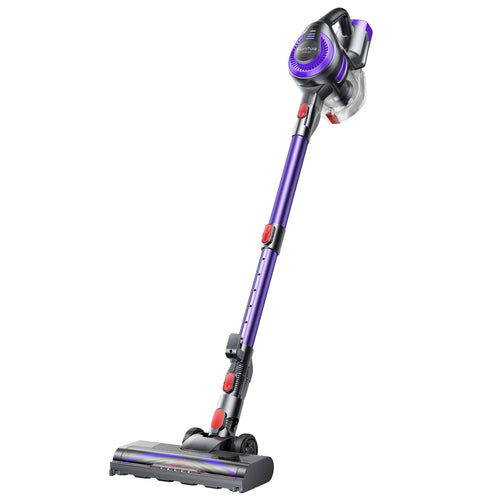
The Honiture X7 and Honiture P7 Pro are both built around this idea. You can detach the extension tube and floor head, and you're left holding a compact handheld unit with the same suction power, ready for a staircase without any long wand to wrestle. Swap in a crevice tool or upholstery brush from there, and you can clean corners, stair edges, and railings without reaching for a second machine.

Carpeted Stairs vs. Wooden Stairs: Different Challenges
You can not clean all staircases the same way, and it helps to adjust your approach based on the surface.Carpeted stairs trap dust, pet hair, and crumbs deep in the fibers, especially along the crease where the tread meets the riser. This buildup isn't always visible from a glance. That's why carpeted stairs often look clean but still release dust when you finally vacuum them properly. Carpet stairs need stronger suction and some brush agitation to lift embedded debris out of the fibers rather than just skimming the surface. If you're not sure how much suction that actually requires, our breakdown of vacuum suction power in Pa is a useful reference. For multi-pet households where fur builds up fast on carpeted treads, the Honiture X7 Pet Version adds a flexible hose and grooming attachment on top of the standard cleaning kit.

Wood doesn't trap dust the way carpet does. Look closely at a wooden staircase and the mess is mostly sitting in the same few spots along the edges, tucked into the corners, wedged in that thin gap where the riser meets the tread. Nothing's ground in. That changes what tool you want in your hand. Skip the motorized brush here, since stiff bristles are more likely to scratch the wood than clean it. A soft brush or dusting attachment handles it better, and there's no need to sweep across the whole step. Just work the edges and corners.
Using the Crevice Nozzle on Gaps and Crevices
A lot of the dust on a staircase never shows up where you'd look for it. It settles into the crack between the baseboard and the wall, along the spindles under the handrail, and in that thin seam where the tread meets the riser. A wide floor brush can't reach any of that, but a crevice nozzle is narrow enough to get in. Run it slowly along the gap instead of sweeping across it, and let the suction pull the dust out rather than trying to scrub it loose. The corners at the top and bottom of the staircase are worth a pass too, since foot traffic tends to skip right over them and dust just sits there building up. A minute or two with the crevice tool in these spots usually catches what a normal pass misses.

Detachable Cordless Vacuums vs. Traditional Handheld Vacuums
Pick up a traditional handheld vacuum, and you can feel why it's limited. The whole thing is built around a small motor and a small battery, which is fine for crumbs on a car seat but runs out of steam fast on anything more demanding. A detachable stick vacuum doesn't have that problem, mostly because it was never designed as a separate product in the first place. Pull off the extension tube, and you're just holding the same motor and battery that power the full-size stick, minus the wand. The difference shows up clearest in the accessories each one comes with.
| Traditional Handheld Vacuum | Detachable Cordless Stick Vacuum | |
| Suction power | Limited by a small motor, fine for light surface debris | Shares the stick vacuum's full motor, strong enough for embedded dirt |
| Runtime | Usually short, around 10 to 20 minutes | Matches the stick vacuum, often 45 to 80 minutes |
| Accessories | Basic, typically just a brush and maybe a crevice tool | Full kit: crevice nozzle, upholstery brush, sometimes a motorized brush |
| Best suited for | Furniture, car interiors, spot cleaning | Stairs, furniture, and full-home floor cleaning from one machine |
Key Criteria for Choosing a Stair Vacuum
If you're comparing options to find the best vacuum for stairs, these five factors matter more than a flashy spec sheet.
Weight. You'll likely be holding the vacuum with one hand while bracing yourself on the railing with the other, sometimes reaching overhead for the top of a doorframe or light fixture nearby. Anything under 6 pounds in handheld mode is far more comfortable for extended use than a heavier unit. The Honiture Y10 is worth a look here if weight is your main concern, since it's one of the lighter options in the lineup. Switching from the Y10 to the X7—which weighs only a few pounds when used with the soft brush or crevice tool. It means your hand won't feel tired during cleaning. 
Battery run time. Stairs don't usually take as long as a full-home clean, but if you're combining stair cleaning with the rest of your routine, look for at least 30–45 minutes of runtime in a lower power mode.
Noise level. Stairwells can amplify vacuum noise more than open rooms do, especially in homes with hard surfaces nearby. A model in the 60–68 dB range is noticeably more pleasant to use in a stairwell than louder options.
Attachment variety. A crevice tool for edges and corners, a motorized brush for embedded carpet debris, and a soft dusting brush for wood surfaces and railings cover the range of surfaces you'll encounter on a typical staircase.
Freedom of detaching and reattaching the handheld unit.
If switching between stick and handheld mode is fiddly, you're less likely to bother doing it regularly. A simple, tool-free release mechanism makes the 2-in-1 design actually convenient rather than a workaround you avoid.
Tips for Efficient Stair Cleaning
| Tip | Why It Works |
| Work top to bottom. | Starting at the top of the staircase means any debris you dislodge falls toward steps you haven't cleaned yet, rather than back onto ones you've already finished. |
| Use the crevice tool along riser edges and corners. | This is where dust and hair collect most on both carpeted and wooden stairs, and a narrow crevice attachment reaches into that gap far better than a standard floor head. |
| Vacuum the handrail and spindles with a dusting brush. | Stair railings collect dust just as much as the treads themselves, and a soft brush attachment clears it without scratching the finish. |
| Finish with a full-stick pass at the bottom. | Once you reach the landing, reattach the extension tube for a final pass to catch anything that settled at the base of the stairs during cleaning. |
Choosing Between the X7 and the P7 Pro for Stairs
Both the Honiture X7 and Honiture P7 Pro convert cleanly between stick and handheld configurations, so the choice mostly comes down to how much house you're cleaning alongside the stairs. The X7 weighs about 5.84 lbs and runs up to 60 minutes on a charge
It is plenty of time for stairs plus a normal-size home. The P7 Pro is a touch heavier at 6.19 lbs but offers up to 80 minutes of runtime, which matters more if your stairs are just one stop in a longer cleaning session covering multiple floors. If you're mainly focused on lighter, quicker cleanups (stairs, a car interior, the occasional couch), the Honiture Y10 is worth a look too, since its compact size and light weight make it easy to carry between rooms even though it doesn't convert to a dedicated handheld the way the X7 and P7 Pro do.
Attachment lineups and exact configurations can vary between vacuum bundles, so check the current listing on each product page for the specific tools included with your model.
For more on choosing the right cordless stick vacuum for carpeted rooms beyond just the stairs, see our guide to the best cordless stick vacuums for carpet cleaning.
FAQs
Can a handheld vacuum handle a full staircase on its own?
Yes, for most homes it can handle it. A lightweight handheld with a crevice tool and a small brush attachment gets through an entire staircase in a few minutes. The one exception is heavily carpeted stairs with deep-pile fibers, where a motorized brush attachment pulls out embedded debris that suction alone would leave behind.
How often should stairs be vacuumed?
Once a week is a reasonable time for most households. You can do it more often if you have pets or high foot traffic. Carpeted stairs in particular benefit from more frequent attention, since dust and debris build up in the fibers even when the surface looks clean.
Is a corded or cordless vacuum better for stairs?
Cordless is almost always the more practical choice for stairs. A cord has to be repositioned at every step and creates a real tripping hazard on a staircase, while a cordless handheld or detachable stick vacuum moves freely without that risk.
What attachment is best for stair corners?
A narrow crevice tool reaches into the tight gap where the riser meets the tread, which is where most dust and hair collects on both carpeted and wooden stairs.
Will a motorized brush scratch wooden stairs?
Stiff bristles can, yes. That's why hardwood stairs generally do better with a soft brush or dusting attachment. Save the motorized brush heads for the carpeted sections of the staircase.
How do I know if my vacuum's battery will last through a full cleaning session?
Don't go by the maximum setting. Look at the runtime for the lower power mode instead, since that number is closer to what you'll actually get day to day. Stairs plus a few rooms on top of that usually calls for something in the 45 to 60 minute range on Eco mode.
Can I use the same vacuum for stairs and my car interior?
You can, and it's one of the better reasons to go with a detachable 2-in-1 design. Whatever handheld unit and attachments work on your stairs will handle car seats, floor mats, and the trunk just as well.